







In industries where air purity is critical, even microscopic particles can compromise product quality, patient safety, and regulatory compliance. That’s why cleanrooms rely on high-performance air filtration systems to maintain controlled environments. One of the most widely used filtration grades is the H13 HEPA filter.
At Rayshen, we manufacture advanced H13 filters that deliver reliable performance for cleanrooms, hospitals, laboratories, and industrial HVAC systems. This guide explains what an H13 hepa filter is, how it works, the standards it follows, and where it is used.
What Is an H13 HEPA Filter?
An H13 HEPA filter is a high-efficiency particulate air filter classified under the EN 1822 European standard. It is designed to remove 99.95% of airborne particles as small as 0.3 microns. This makes it ideal for environments that require high cleanliness levels but do not need the extreme filtration of H14 filters.
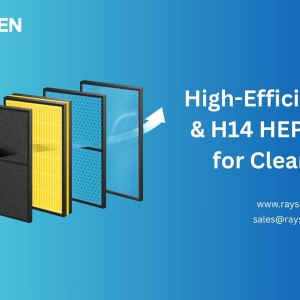
The filter media is made from ultra-fine micro-glass fibers arranged in deep pleats. This structure maximizes surface area, allowing efficient airflow while capturing harmful contaminants such as dust, bacteria, mold spores, and aerosols.
Efficiency of an H13 HEPA Filter
The key performance feature of an H13 filter is its 99.95% filtration efficiency. This means that out of 100,000 particles, only 50 may pass through.
This level of efficiency ensures:
- Removal of fine dust and airborne microbes
- Reduced risk of contamination
- Improved indoor air quality
- Compliance with ISO cleanroom standards
Rayshen H13 filters are individually tested to ensure they meet performance and leak integrity requirements before installation.
EN 1822 Standards Explained
The EN 1822 standard classifies high-efficiency filters based on their ability to capture the Most Penetrating Particle Size (MPPS).
|
Filter Class |
Efficiency |
|
H13 |
≥ 99.95% |
|
H14 |
≥ 99.995% |
An H13 hepa filter is suitable for ISO Class 7 and 8 cleanrooms, hospital theatres, laboratories, and controlled production areas.
How H13 Filters Work in Cleanrooms
H13 filters remove particles through three physical mechanisms:
- Interception – particles stick to filter fibers
- Impaction – larger particles collide with fibers
- Diffusion – ultra-fine particles move randomly and attach
This multi-layered process ensures superior air purification across cleanroom zones.
Integration with FFU and Fan Filter Units
An FFU or fan filter unit is one of the most common systems that houses an H13 filter.
Here’s how the system operates:
- The FFU draws air from the ceiling plenum.
- Air passes through the H13 HEPA filter.
- Clean air flows downward in a laminar pattern.
Rayshen FFUs are engineered to maintain uniform airflow, low noise, and stable filtration performance.
Supporting Clean Room Equipment
A cleanroom is a complete system. Along with filters, several components help prevent contamination.
Air Shower
An air shower removes dust from personnel before entry.
SS Sink
An ss sink ensures hygienic handwashing in gowning areas.
Other Clean Room Equipment
Pass boxes, HEPA housings, pressure control systems, and monitoring devices support air cleanliness.
Uses of H13 HEPA Filters
- Pharmaceutical cleanrooms
- Hospitals and operation theatres
- Diagnostic laboratories
- Electronics manufacturing
- Food and beverage processing
- Research and testing facilities
Why Choose Rayshen H13 HEPA Filters?
Rayshen H13 filters are designed for durability, efficiency, and compliance.
Benefits:
- EN 1822 certified performance
- Leak-tested for safety
- Compatible with FFU and HVAC systems
- Long service life
- Custom sizes available
Conclusion
An H13 HEPA filter is a reliable solution for maintaining clean, safe, and compliant environments. When combined with fan filter unit systems, air shower, ss sink, and other clean room equipment, Rayshen H13 filters deliver complete contamination control for critical industries.